
Executive Summary:
Health plans must ensure network adequacy to meet regulatory requirements, maintain consumer trust, and provide a fulfilling member experience. However, network adequacy remains a fundamental challenge for plans due to inaccuracies in provider data. Health plans struggle with outdated or incomplete provider information, which hampers their ability to assess and maintain adequate networks for their members. Traditional solutions have often been limited, focusing narrowly on compliance without addressing underlying data quality issues. These approaches can create “ghost” networks, leading to member dissatisfaction, potential regulatory risks, and significant operational inefficiencies.
Root of the Problem:
Inaccurate data on in-network providers within health plan directories is a phenomenon notoriously known as “ghost” networks. HiLabs research published in JAMA examined provider directory entries for more than 40% of U.S. physicians and found inconsistencies in 81% of entries across five large national health insurers. Providers face a tremendous burden in sending directory updates to insurers via disparate technologies, schedules, and formats, which costs physician practices a collective $2.76 billion annually. Additionally, health plans have incomplete and inaccurate source data on providers outside of their networks. While obtaining accurate information from in-network providers is challenging enough, acquiring the same information from out-of-network providers is nearly impossible for a health plan.
Traditional Solutions:
There is a strong need for a network adequacy solution that uses accurate provider data to assess a plan’s true network adequacy. Unfortunately, traditional solutions to address network adequacy are narrowly focused on adequacy and rely on inaccurate provider information. These approaches to evaluating network adequacy are based on faulty underlying data and the presence of ghost provider locations. This can introduce further regulatory risk in the adequacy domain if provider data inaccuracies are uncovered during regular external audits.
HiLabs NetworkIQ:
Managing network adequacy requires a holistic and strategic approach. An ideal solution needs to start with a clean foundation of accurate provider data, which can then support efforts to improve adequacy. NetworkIQ is powered by HiLabs’ industry-leading R3 approach for provider data accuracy and addressing ghost providers. This AI engine evaluates thousands of publicly available sources and internal health plan-specific provider data sources, weighing them on the parameters of reliability, recency, and relevance (collectively known as “R3”). It then creates confidence ratings on the accuracy of each provider data element and provides customized recommendations to improve provider data quality. This feeds into NetworkIQ, allowing health plans to understand both their network adequacy and accuracy using accurate provider data.
NetworkIQ Overview:
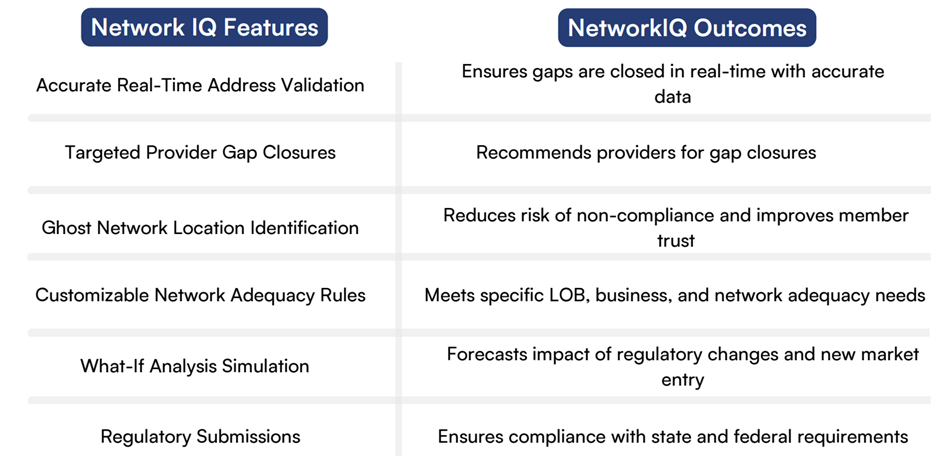
NetworkIQ uses this same R3 technology to generate accurate information for sourcing new providers in areas of need to improve adequacy and/or competitiveness. By rapidly identifying providers that can close network gaps, NetworkIQ can drastically reduce manual labor, time, and costs related to provider recruitment and network management. The true power of the HiLabs NetworkIQ solution is unlocked when health plans integrate this provider information via the intuitive NetworkIQ interface to simulate, in real-time, changes in network adequacy based on network management actions. NetworkIQ makes suggestions on the optimal providers to add or remove to maintain compliance, and health plans can immediately visualize the impact of these changes on network adequacy using a ‘what-if’ analysis.
Case Study: NetworkIQ at a Large Health Plan

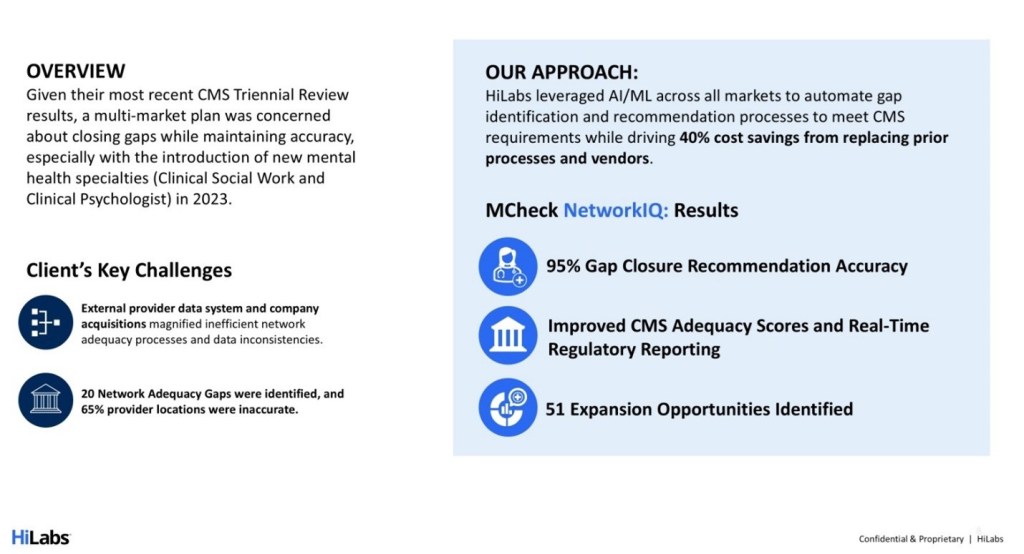
Transforming Network Management:
From Compliance, Competitiveness, Cost of Care, and Beyond
As health plans look to the future, HiLabs NetworkIQ offers tremendous benefits beyond compliance. NetworkIQ easily compiles all requisite information for regulatory submissions at all levels. However, improving network adequacy for compliance requirements is just the starting point for what health plans can do with this technology. The same NetworkIQ interface can be leveraged to assess market competitiveness. A health plan can evaluate how its network compares to other plans in the same market across network size, pricing, and product dimensions. NetworkIQ leverages AI to integrate clinical, claims, and member data, enabling health plans to proactively forecast and assess how adding or removing providers can support network expansion across products, lines of business, or geographies. This unique capability helps improve network performance by identifying cost savings and enhancing care quality.
Conclusions
HiLabs NetworkIQ offers a holistic solution for end-to-end, strategic network management, transforming how health plans approach network adequacy and more. By leveraging AI-driven data accuracy and real-time insights, NetworkIQ goes beyond compliance to empower health plans with a comprehensive, proactive strategy for optimizing provider networks. This holistic approach enhances member experience, streamlines provider recruitment, and reduces operational costs, making network adequacy a key competitive advantage. With NetworkIQ, health plans are equipped to navigate regulatory requirements today and innovate for the future, ensuring improved access to care and robust network performance.
At the Becker's 5th Annual Fall Payer Issues Roundtable, taking place November 17–19 in Chicago, payer executives and healthcare leaders will come together to discuss value-based care, regulatory changes, cost management strategies and innovations shaping the future of payer-provider collaboration. Apply for complimentary registration now.
